
Last updated: October 1, 2026
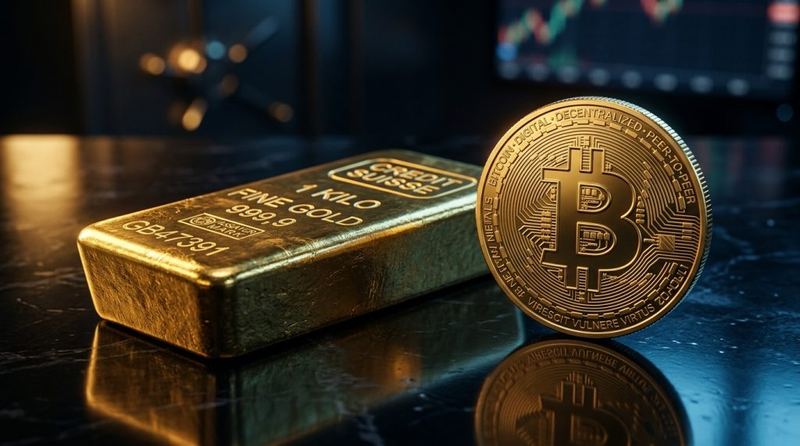
The debate is everywhere: gold or Bitcoin? One is 5,000 years old, tangible, and held by every central bank. The other is 16 years old, digital, and has made — and destroyed — fortunes in months. They’re often pitched as interchangeable “hard money” alternatives to fiat, but the reality is much more nuanced. Here’s the honest 2026 breakdown.
The Quick Answer
Gold is the better store of value if you care about stability, low correlation to stocks, and a 5,000-year track record. Bitcoin is the better asymmetric bet if you can stomach 70%+ drawdowns and believe in its long-term adoption curve. They’re not substitutes — they serve different portfolio purposes.
Head-to-Head Comparison
| Factor | Gold | Bitcoin |
|---|---|---|
| Track Record | 5,000 years | 16 years |
| 2021-2026 Annualized Return | ~8% | ~25% (with huge swings) |
| Annual Volatility | 15% | 72% |
| Max Historical Drawdown | -33% | -77% |
| Correlation to S&P 500 | 0.1 (near zero) | 0.45 (moderate) |
| Supply Cap | Mined ~1.5%/yr | Fixed 21M |
| Physical Form | Yes | No |
| Central Bank Holdings | 35,000+ tonnes | El Salvador, Bhutan |
| IRA Eligible | Yes (Gold IRA) | Yes (Crypto IRA) |
| Annual Storage Cost | 0.5% – 1% | 0% (self-custody) |
1. Volatility: Gold Wins Comfortably
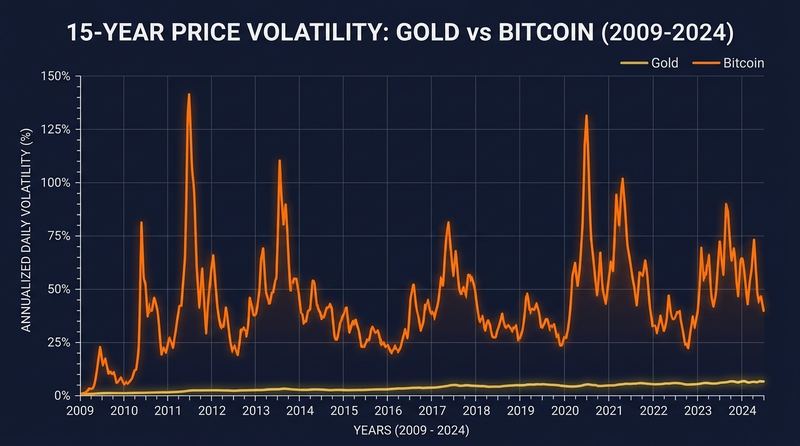
Bitcoin has delivered much higher returns since 2016, but at a cost: its annual volatility is roughly 5x that of gold. Over the past decade, Bitcoin has had four drawdowns exceeding 50%, including the 2022 bear market that wiped out -77% from peak to trough. Gold’s worst drawdown in the same period was about -18%. For a deeper dive into providers, see top-rated Gold IRA providers.
For a store of value — the purpose of preserving purchasing power through uncertainty — volatility is the enemy. If your gold portfolio drops 10% in a crisis, you’re annoyed. If your Bitcoin drops 70%, you may be forced to sell at the worst possible time.
2. Correlation and Diversification
Gold has a correlation of about 0.1 to the S&P 500, meaning it moves almost independently of stocks. That’s why it’s so effective as a diversifier — when equities crash, gold often holds steady or rises.
Bitcoin was sold as “digital gold” but has acted more like a high-beta tech stock during major market events. Its correlation to the Nasdaq climbed to 0.5 — 0.7 during the 2022 selloff, meaning it dropped exactly when investors needed diversification most.
3. Adoption and Legitimacy

Central banks bought over 1,000 tonnes of gold in 2024, according to the World Gold Council. Gold is a reserve asset led by China, Turkey, and India.
Bitcoin’s institutional adoption has grown fast: spot Bitcoin ETFs launched in the U.S. in 2024, BlackRock’s IBIT has over $40 billion in assets, and El Salvador and Bhutan hold it on their sovereign balance sheets. But this is still a fraction of gold’s legitimacy.
4. Inflation Hedge Performance
Gold has a well-documented track record as an inflation hedge dating back centuries. From 1971 (the end of the gold standard) to 2026, gold’s real return after inflation is positive despite multiple drawdowns.
Bitcoin’s hedge credentials are less clear. In the 2022 inflation spike, Bitcoin fell -65% — the opposite of what an inflation hedge should do. Its price is still driven more by risk appetite than by inflation data.
Use our Inflation Hedge Calculator to compare how gold would have preserved your purchasing power versus other assets across different historical periods.
5. Practical Considerations
- Physical vs digital: Gold is tangible — you can hold it, bury it, hand it to your children. Bitcoin exists only on the blockchain and depends on electricity, internet access, and your ability to safely manage private keys.
- Storage and theft: Gold needs a safe or depository. Bitcoin can be stolen by hackers, lost to forgotten passwords, or frozen if kept on exchanges. Both have security costs, just different kinds.
- Regulation: Gold is regulated under well-understood commodity law. Bitcoin’s regulatory status is still evolving — the IRS, SEC, and CFTC all treat it differently.
- Counterparty risk: Physical gold has zero counterparty risk. Bitcoin held on an exchange is an IOU from that exchange (see: FTX, Celsius, Mt. Gox).
Which Should You Own?
- Conservative investors (55+, near retirement): Heavily favor gold. Stability and low correlation matter more than upside.
- Moderate investors: A 10-15% gold allocation with a small Bitcoin position (1-3%) captures both safety and optionality.
- Aggressive investors (under 40): Can tolerate more Bitcoin exposure, but gold should still anchor the “hard asset” sleeve of your portfolio.
The smart play for most investors isn’t either/or — it’s and. Own enough gold to sleep at night, and a measured Bitcoin position you could afford to lose.
FAQ
Is Bitcoin a better investment than gold?
Over the last 10 years, Bitcoin has delivered higher returns — but with dramatically more risk. For capital preservation, gold is better. For asymmetric upside, Bitcoin. Most portfolios benefit from holding both.
Do central banks hold Bitcoin?
A tiny handful (El Salvador, Bhutan) hold Bitcoin on their balance sheets. Almost every central bank on earth holds gold — collectively over 35,000 tonnes.
Can I hold Bitcoin in a Gold IRA?
No — a “Gold IRA” specifically holds precious metals. But you can open a separate Crypto IRA for Bitcoin exposure with providers like BitIRA or iTrustCapital. Learn more about how Gold IRAs work.
Which is a better inflation hedge?
Gold has a centuries-long track record of preserving purchasing power. Bitcoin’s inflation-hedge credentials are mixed — it fell sharply during the 2022 inflation spike.