
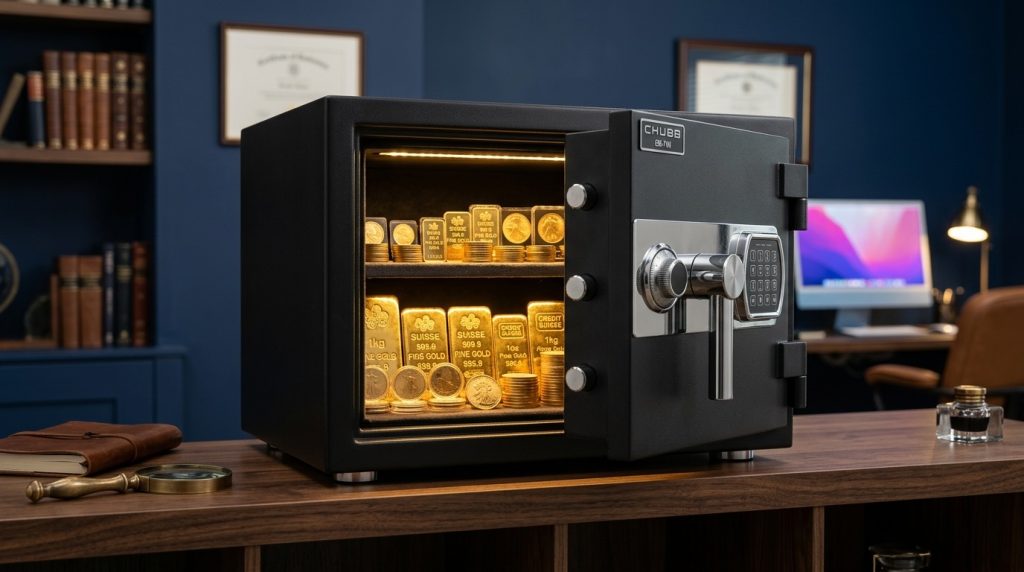
You bought the gold. Now where do you keep it? This is the question most new investors never seriously consider — until they realize a home fire, burglary, or natural disaster could wipe out their entire allocation. In 2026, you have three main options for storing physical gold: a home safe, a bank safe deposit box, or a private depository. Each has clear tradeoffs on cost, security, accessibility, and insurance.
The Three Storage Options
| Method | Annual Cost | Insurance | Access | Best For |
|---|---|---|---|---|
| Home Safe | $0 (after purchase) | Self (homeowner’s rider) | Instant 24/7 | Small holdings under $25,000 |
| Bank Safe Deposit Box | $50 – $300 | Not covered by FDIC | Bank hours only | Medium holdings, document storage |
| Private Depository | 0.5% – 1% of value | Full Lloyd’s of London | Appointment only | Large holdings, Gold IRAs |
Option 1: Home Safe
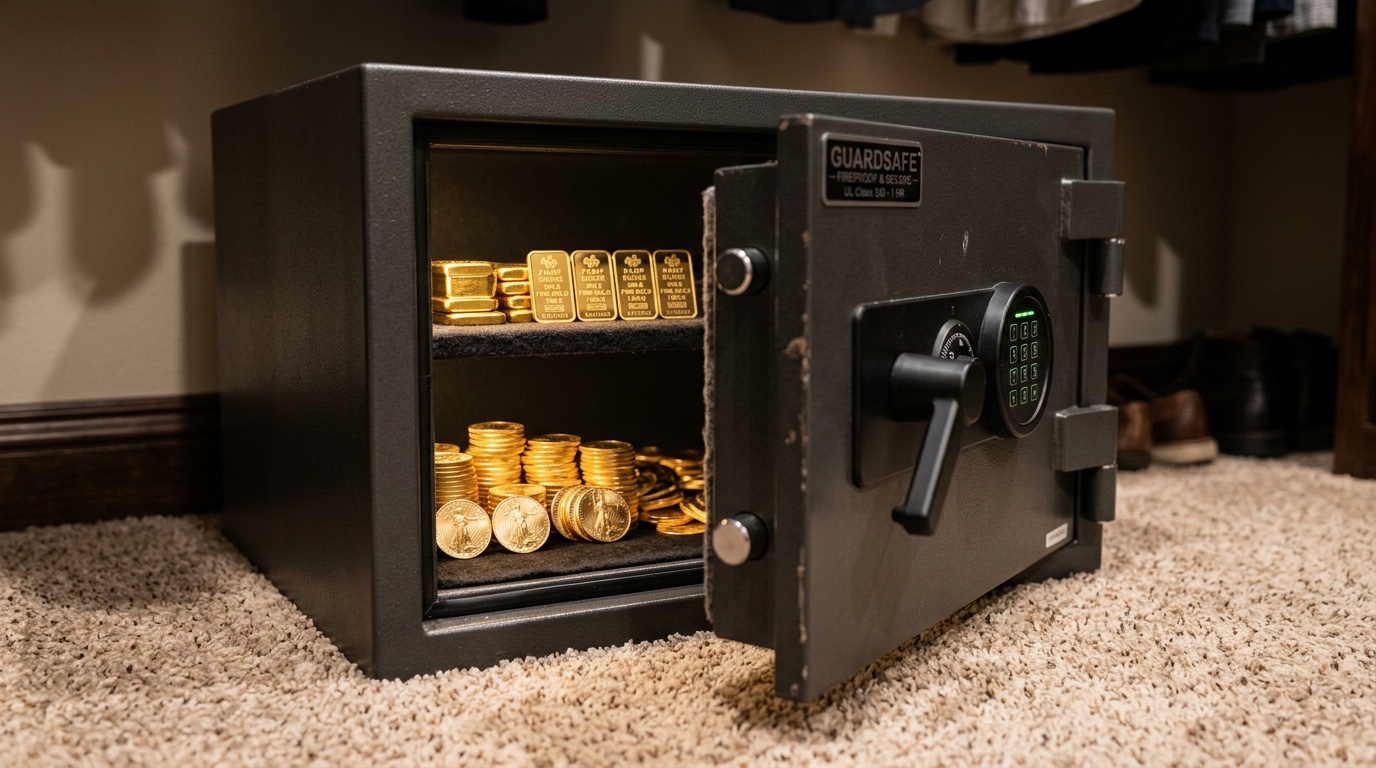
A home safe gives you full control and instant access, with no annual fees. If you want to physically hold your gold in a crisis, this is the only option that lets you do that. But home safes come with real risks: theft, fire, and insurance coverage gaps.
What to buy: A UL-rated TL-30 burglary safe bolted to the floor, with at least a 2-hour fire rating. Expect to pay $1,500 – $5,000 for a quality safe.
Insurance reality check: Most homeowner’s policies cap gold and jewelry coverage at $1,500 – $2,500 unless you purchase a scheduled personal property rider. A rider typically costs $10 – $20 per $1,000 of declared value per year. At $500,000 of gold, that’s $5,000 – $10,000 per year.
Pros: Instant access, no ongoing fees, full privacy, no counterparty risk.
Cons: Theft and fire risk, insurance cost for larger holdings, physical space limits.
Option 2: Bank Safe Deposit Box

A bank deposit box is cheap and secure, but comes with a critical gotcha: its contents are NOT covered by FDIC insurance. FDIC only insures deposit accounts. If your bank is robbed or flooded, the bank’s own insurance may or may not reimburse you for lost gold — and most banks explicitly disclaim responsibility.
Cost: $50 – $300 per year depending on box size and bank. Often discounted for existing customers.
Access: Bank hours only. You cannot access your gold at 2am or on a holiday, and banks occasionally restrict access during crises (as happened during COVID lockdowns).
Pros: Very low cost, secure vault environment, private.
Cons: No FDIC coverage, limited hours, not suitable for Gold IRAs (custodian must be an approved depository), risk of bank failure or seizure.
Option 3: Private Depository

Private depositories like Delaware Depository, Brink’s Global, and IDS of Texas are purpose-built vaults with 24/7 armed security, biometric access control, and full Lloyd’s of London insurance on every ounce. They’re also the only legal choice for Gold IRA storage — the IRS requires your Gold IRA metals to sit with an approved custodian.
Cost: Typically 0.5% to 1.0% of the metal value per year. Flat-rate options exist for smaller accounts (e.g., $100 – $200/year).
Allocated vs. Unallocated: Always choose allocated (also called segregated) storage. Your specific bars and coins are stored separately with your name on them. Unallocated storage means the depository can lend or hedge your metals.
Pros: Fully insured, professional security, required for Gold IRAs, auditable.
Cons: Annual fees, delayed physical access, counterparty risk (choose reputable custodians only).
How to Decide
The right choice depends on how much gold you own and why you bought it:
- Under $25,000 and you want crisis access: Home safe with a proper rider on your homeowner’s insurance.
- $25,000 to $250,000 for long-term holding: Split it — keep $5,000–$10,000 at home for emergencies, and the rest in a private depository.
- Gold IRA (any amount): You are legally required to use an IRS-approved depository. Do not try to store IRA metals at home.
- $250,000+: Private depository with allocated storage and full insurance. The cost is trivial compared to your insurance exposure.
Not sure how much gold you should own in the first place? Use our Gold Allocation Calculator to get a personalized recommendation based on your age, portfolio, and risk tolerance.
FAQ
Can I store my Gold IRA at home?
No. Despite “home storage Gold IRA” marketing you may see, the IRS requires IRA-owned metals to be held by an approved custodian. Storing IRA gold at home can trigger a distribution, full taxation, and a 10% early withdrawal penalty.
Is a safe deposit box insured?
Not by the FDIC. Some banks offer limited contents insurance, but it’s rarely enough to cover significant gold holdings. You’ll need a private rider or depository insurance instead.
What’s the safest way to store gold long-term?
For most investors, an IRS-approved private depository with allocated storage and Lloyd’s of London insurance offers the best combination of security, insurance, and cost.
How much does it cost to insure gold at home?
A scheduled personal property rider typically costs $10 – $20 per $1,000 of declared value annually. For $100,000 in gold, expect $1,000 – $2,000 per year.