

When the economy turns, investors scramble for assets that hold their value. Historically, one asset has outperformed almost everything else during severe recessions: gold. This isn’t hype — it’s data. Across the last five major U.S. recessions, gold delivered positive returns in four of them while the S&P 500 fell. Here’s exactly how gold has performed during past downturns, and what that means for 2026.
Gold Performance in Past Recessions
| Recession | S&P 500 Return | Gold Return | Difference |
|---|---|---|---|
| 1973 – 1975 (Oil Crisis) | -42% | +87% | +129% |
| 1980 – 1982 (Volcker Recession) | -17% | +24% | +41% |
| 1990 – 1991 (Gulf War) | -15% | +1% | +16% |
| 2001 – 2002 (Dot-com Bust) | -37% | +12% | +49% |
| 2007 – 2009 (Great Recession) | -56% | +25% | +81% |
| 2020 (COVID) | -34% then recovered | +25% | +59% |
Why Gold Thrives When Stocks Crash
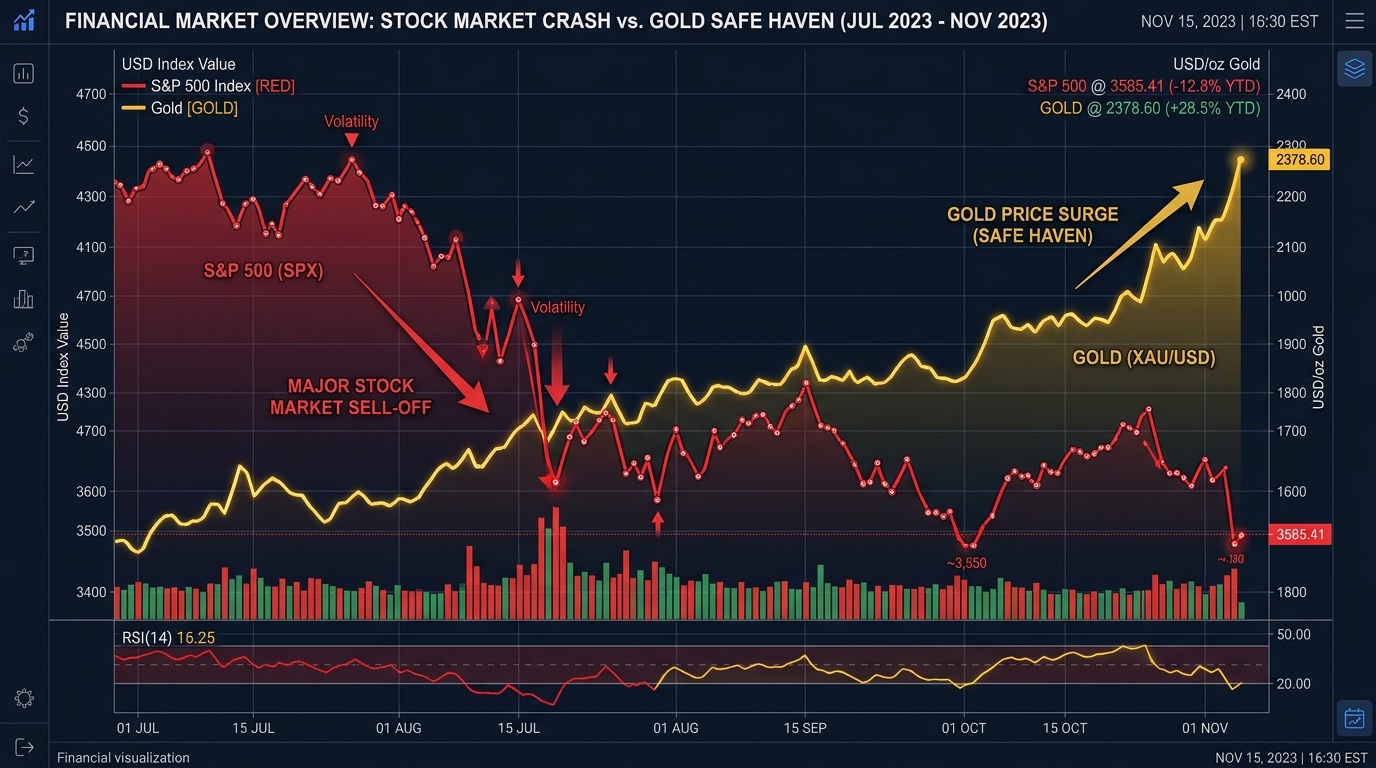
Three factors drive gold’s recession outperformance:
- Flight to safety. When investors lose faith in equities, they move capital into perceived safe havens: U.S. Treasuries, the dollar, and gold. Gold is the only one of those that has no counterparty risk.
- Rate cuts. Central banks slash interest rates during recessions. Lower real rates reduce the opportunity cost of holding gold (which pays no yield), making it relatively more attractive.
- Money printing. Recessions trigger quantitative easing and fiscal stimulus. When the money supply expands rapidly, gold historically rises to preserve purchasing power.
The 2008 Case Study

The Great Recession is the cleanest modern example of gold’s safe-haven behavior. Between October 2007 and March 2009:
- The S&P 500 fell -56%.
- U.S. real estate lost ~30% of its value.
- Financial stocks lost -83%.
- Gold rose +25% in the same window.
More striking: in the three years after the 2008 bottom, as central banks unleashed quantitative easing, gold went on to nearly double, hitting an all-time high of $1,895/oz in September 2011.
The 2020 COVID Case Study
COVID’s crash was fast and unusual. In March 2020, nearly every asset class sold off simultaneously — even gold fell about -12% as investors liquidated everything for cash. But within weeks, gold rebounded. By August 2020 it had set a new all-time high above $2,000/oz. Over the full calendar year, gold returned +25% while the S&P 500 ended +16% (after a brutal March drawdown).
The lesson: even in liquidity-crisis panics, gold recovers quickly and then outperforms as stimulus ramps up.
2026 Recession Outlook
As of early 2026, recession indicators are mixed:
- The U.S. yield curve has been inverted on and off since late 2024 (historically a recession signal).
- Unemployment has ticked up from 3.5% to 4.2%.
- Leading economic indicators (LEI) have declined for 10+ consecutive months.
- The Fed has signaled a pause-and-cut cycle, which historically benefits gold.
We don’t forecast recessions at this site, but we do note that the conditions for a recession exist — and gold has a long track record of performing during those conditions. Use our Inflation Hedge Calculator to see how gold has preserved purchasing power during past downturns versus cash, bonds, and stocks.
How to Position Your Portfolio
- Own some gold now. You can’t time the bottom of a recession. Most advisors recommend 5-15% of a portfolio in precious metals as a baseline.
- Increase your allocation as recession signals strengthen. Conservative investors often push gold to 20-25% during high-risk periods.
- Use a mix of physical and IRA. Physical gold gives you crisis-proof optionality. A Gold IRA gives you tax-advantaged long-term exposure.
- Diversify within metals. Gold is the foundation, but silver, platinum, and palladium can add upside during recovery phases.
FAQ
Does gold always go up in a recession?
Not always. Gold occasionally sells off initially during liquidity crises (March 2020 is the classic example), but it historically rebounds quickly and outperforms stocks over the full recession window.
How much gold should I own if a recession is coming?
Most advisors recommend 5-15% of your portfolio as a baseline allocation, increased to 15-25% if you expect heightened economic stress. Use our Gold Allocation Calculator for a personalized recommendation.
What’s the best way to buy gold before a recession?
Physical gold (bars and coins) for crisis access, a Gold IRA for tax-advantaged growth, and gold ETFs for liquidity. Most investors use a mix of all three.
Has gold ever lost value during a recession?
Gold fell during the brief 1980-1982 recession peak (but gained overall), and initially dropped about -12% during the March 2020 COVID panic before recovering. In the 1990-1991 recession gold was roughly flat. Long-term net returns during recessions have been consistently positive.